🧠 Gifted & Advanced · 9×9 & 10×10 · Grand Prix Pressure

She Beat 4×4 in 90 Seconds. Then We Gave Her the 9×9.

Kavya completes things quickly. Books, puzzles, maths — she's done before you've finished explaining. The 9×9 Kidoku grid with live Grand Prix opponents is the first thing in months that made her slow down and actually think. Still thinking, fourteen minutes later.

verified_user 4×4 through 10×10 · Grand Prix & Hall of Fame · Real challenge at every size

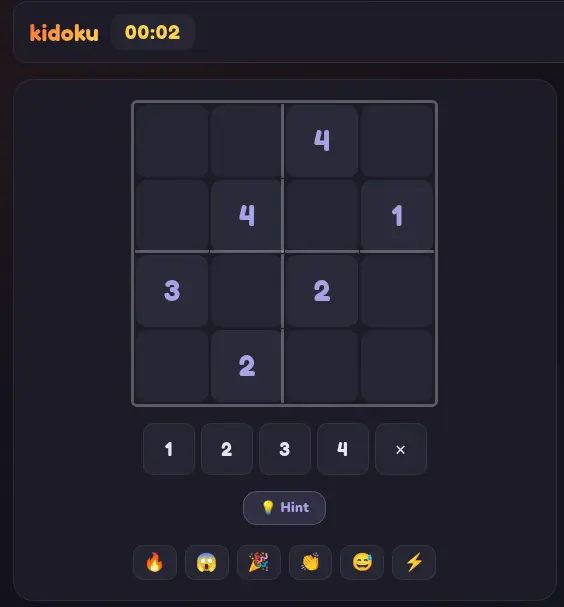
kidoku live screen

9×9 Grand Prix

LIVE
{['2','_','7','_','4','_','9','_','1'].map ? ['2','_','7','_','4','_','9','_','1'] : ['2','_','7','_','4','_','9','_','1']}
{['2','·','7','·','4','·','9','·','1','·','5','·','8','·','3','·','6','·','4','·','1','·','6','·','3','·','7','·','2','·','8','·','5','·','9','·','3','·','8','·','2','·','5','·','1','·','6','·','4','·','7','·','·','·','·','·','·','·','·','·','·'].map((c,i)=>`
${c}
`).join('')}
SwiftOwl22 · 14:33 3rd of 8 · Still solving…
"Still thinking 🧠"

The Grid That Made Her Stop and Think

Kavya is ten and reads two years ahead. She does maths in her head faster than most adults do it on paper. Her parents are used to the particular exhaustion of parenting a child who finishes everything too quickly and then announces they're bored.

The 4×4 Kidoku grid took her about two minutes the first time. She asked for the next size. They showed her the 6×6. Four minutes. She was out of her chair before the results loaded.

The 9×9 was different. The constraint pattern expands non-linearly between 6×6 and 9×9 — the same row-and-column logic, but applied across a grid where the solution space is exponentially larger. Kavya sat back down. She started the grid, worked through the first cluster, and stopped moving when she hit the first ambiguous zone.

Fourteen minutes and twenty-two seconds. 3rd out of eight players in her Grand Prix session. She said: "That was actually hard." Her parents hadn't heard that in months.

She moved to Grand Prix — the multi-round format where cumulative time determines ranking. A single fast solve doesn't win it. Consistent, accurate, fast elimination logic across four rounds. She placed 5th in her first Grand Prix. She asked to try again the next day.

The Hall of Fame leaderboard for 9×9 showed the top all-time solve was 11:04. She wrote it down. She has a target now. The first real one in a while.

Scale to the Actual Challenge Level

The complexity of Kidoku grids scales genuinely — not just more cells, but exponentially more constraint resolution required. 9×9 demands different logic from 6×6.

📐

1. Choose the Right Grid Size

Start at the size that produces friction, not defeat. For many gifted children, that's 8×8 or 9×9. The constraint logic genuinely increases in complexity — a 9×9 is not simply a bigger 6×6.

🏎️

2. Enter Grand Prix

Grand Prix adds multi-round competition. Winning requires consistency across four rounds, not just one fast solve. It's the format that genuinely tests an advanced child — one good solve won't carry the series.

🥇

3. Target the Hall of Fame

The Hall of Fame leaderboard shows the all-time fastest solves for each grid size. For a child who finishes everything too quickly, the Hall of Fame is a genuine long-term benchmark — not easily reached, but reachable.

Real Complexity. Real Opponents. Real Benchmark.

psychology

Constraint Logic That Scales

Moving from 6×6 to 9×9 requires new elimination strategies, not just faster execution of the same approach. The puzzle is genuinely harder, not just wider. Advanced solvers can still improve at 10×10.

leaderboard

Hall of Fame: A Real Target

The Hall of Fame shows all-time records per grid size. For a child who routinely has no external benchmark, this is one that adjusts difficulty automatically. You can't game the Hall of Fame. You have to earn it.

groups

Global Opponent Pool

Grand Prix sessions draw from the global player base. Your child doesn't have to be the fastest in their class — they're competing against anyone in the world playing at that grid size right now.

Hall of Fame · 9×9 Classic

🥇

CrypticFox88

All time record

11:04

🥈

GridMaster99

2nd all time

11:41

🥉

SwiftOwl22

Today · Personal best

14:22

SwiftOwl22 wrote down 11:04. She has a target.

Safe for Independent, Long Sessions

A 9×9 Grand Prix can take 15–20 minutes per session. Your child will be absorbed and focused. The environment is designed to be safe for extended independent play.

  • check

    No chat — Grand Prix sessions have no player-to-player communication. Your child is competing, not conversing.

  • check

    Auto-generated usernames — SwiftOwl22, CrypticFox88. No real names show anywhere in the session.

  • check

    No external links — the game is entirely contained. Nothing to click out of, no content beyond the puzzle and leaderboard.

Try the 9×9 Now
🧩

The first thing in months that made her say: "That was actually hard."

A 9×9 Grand Prix. Real opponents. A Hall of Fame record to chase. The challenge is genuine. The target is reachable. The environment is safe.

FAQ

Frequently Asked Questions

Everything you need to know about Kidoku Live for this use case.

Is there a sudoku challenge hard enough for gifted children?

The 9×9 Classic and 10×10 Challenge grids on Kidoku Live provide genuine difficulty for gifted children. More importantly, the global Grand Prix adds the competitive dimension — gifted children are tested not against peers but against skilled players worldwide. Placing in the top 10 globally requires real mastery, not just relative performance within a class or family.

What is the Hall of Fame and why does it matter for high-ability students?

The Hall of Fame records the fastest all-time completion times for each grid size globally. It is a pure performance benchmark — no grade inflation, no participation awards. High-ability students who reach the Hall of Fame have achieved something genuinely rare. This external benchmark motivates beyond internal school metrics.

Is 9×9 sudoku appropriate for an 11-year-old?

Yes, for children with strong pattern recognition and logical reasoning. Most gifted 10–12 year olds can solve a 9×9 grid within 15–20 minutes after a few practice sessions. Competitive times in the Grand Prix require deeper technique — box-line reduction, pointing pairs, X-wings — which provides ongoing learning headroom.

How does Kidoku Live challenge gifted students differently from classroom tools?

Classroom gifted programmes often extend within the same knowledge domain (harder problems of the same type). Kidoku Live extends into a different performance dimension — speed, consistency, and competitive ranking against a global pool. This provides external validation that classroom extension activities alone cannot offer.

Give Them the 9×9. See What Happens.

Start at the grid size that produces friction. Enter Grand Prix. Let the Hall of Fame become the target. For the first time in a while, they'll have to actually try.

4×4 → 10×10 · Grand Prix · Hall of Fame · No account needed

Real Sudoku Challenge for Gifted Children — Live Global Opponents

Gifted children exhaust most puzzle apps within days and return to the same boredom that made them difficult to engage in the first place. Kidoku Live offers something different: 9×9 and 10×10 grids against real live opponents from around the world, a global Hall of Fame, and no ceiling to improvement. It is a genuine intellectual challenge that grows with the child.

Why Most Puzzle Apps Are Too Easy for Gifted Learners

Solo puzzle apps allow unlimited time, offer hints, and have no consequence for being slow. Gifted children quickly recognise this and disengage. Kidoku Live adds the one variable that changes everything: time pressure with real human competition. A gifted child who has never cared about a sudoku app will care intensely about beating the person in second place.

9×9 and 10×10 Against the World

The 9×9 Classic grid is a genuinely hard challenge for most adults. The 10×10 grid is rarer still — very few apps offer it — and represents a significant logical step up. Gifted children who have plateaued on other puzzle games find that the 10×10 gives them weeks of genuine difficulty, especially when competing live against other strong players globally.

The Hall of Fame — A Benchmark Worth Chasing

Kidoku Live maintains a global Hall of Fame tracking the fastest completion times for each grid size. Gifted children respond strongly to having a concrete, world-ranked benchmark to pursue. Unlike school assessments, the Hall of Fame is updated in real time and compares the child against the entire global player pool.

Frequently Asked Questions

What makes this harder than a standard sudoku app?

Live global opponents add genuine time pressure, and the 10×10 grid is a level of difficulty very few apps offer. The combination of hard puzzles and real competition removes the easy-out of going at your own pace.

Is there a leaderboard?

Yes. A global Hall of Fame shows fastest completion times by grid size. Players can track personal bests across sessions and see exactly where they rank against the world.

Is Kidoku Live free?

Yes. The entire game — Quick Match, Grand Prix, private rooms, and all themes — is completely free to play. No subscription is needed to access any feature.

Does it require an account or sign-up?

No account is required. Players join with a 4-letter room code and are assigned a safe auto-generated username for the session. No personal information is collected.

Also see: Competitive sudoku for kids who need real opponents · Winning your first Grand Prix

Related Guides