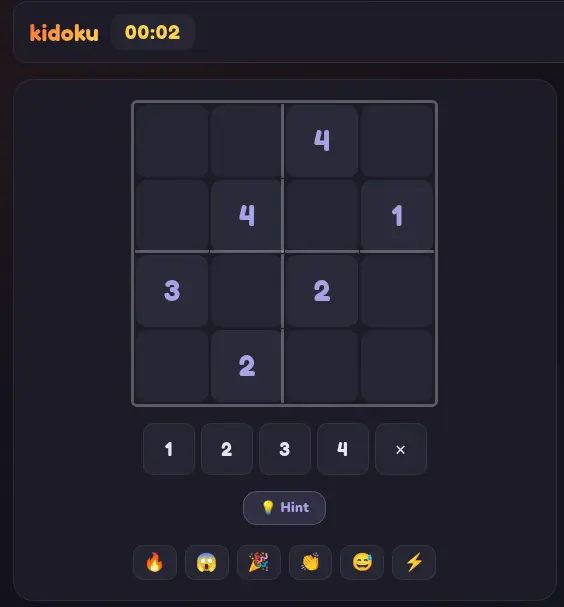
The brain break at 10:30 resets focus. The Grand Prix at 4 PM is something to work toward all day. And the 20 minutes your child spends genuinely absorbed in a puzzle session is 20 minutes you can use for something else.
verified_user No accounts · No prep · Curriculum-adjacent by design
Homeschool Day
Nadia has been homeschooling her son Arjun for two years. The hardest part isn't the curriculum. It's maintaining focus across a full day at home with no external structure — no bell, no peer expectation, no shared momentum.
She introduced Kidoku at 10:30 AM as a deliberate brain break. Twenty minutes between the maths block and the writing session. Arjun initially saw it as another lesson. Within three days, he understood the difference: this one had a timer and opponents. He started asking if it was 10:30 yet.
The 4 PM Grand Prix became a reward structure she hadn't planned on. Arjun arrived at it himself: "If I finish my reading before 3:30, can I do a full Grand Prix?" The answer was yes. The reading finished at 3:22. On a Tuesday. Without being asked.
What Nadia noticed about the break wasn't just that Arjun was engaged. It was that he was engaged without her. The session runs itself. She used to supervise every activity. During the Kidoku break, she made coffee, answered two emails, and sat for a few minutes without managing anything.
Twenty minutes of independent, self-directed, cognitively active engagement. In homeschool terms, that's rare. In practitioner terms, it's a brain break that actually meets the brief: distracted from the previous work, but not idle.
The day has a shape now. 10:30 break. 4 PM reward. Arjun has started tracking his Grand Prix rank and mentioning it at dinner. Nadia has started scheduling her own tasks around 4 PM.
Put it in the morning as a break. Put it in the afternoon as a reward. Both roles work. Neither requires you to set anything up in advance.
Book 20 minutes mid-morning. Quick Match or a short Grand Prix session. The puzzle resets focus without being passive — your child's brain is still working, just on a different kind of problem.
Link the Grand Prix to task completion. "Finish your writing and you can do Grand Prix at 4." The Grand Prix at 4 PM becomes the target for the whole afternoon. Tasks finish earlier.
Kidoku logs session results. Your child tracks their own rank improvement without needing your involvement. Self-directed progress monitoring — a metacognitive skill you don't have to teach directly.
Kidoku puzzles teach constraint-based elimination logic — the kind of thinking behind maths and science problem solving. It supports the curriculum without duplicating any specific lesson content.
The game explains itself. A first-time player in session mode figures it out within one round. No tutorial reading, no parental walkthrough. Your child starts, plays, and improves without you.
Grand Prix rankings update in real time. Your child can see whether this week's 4 PM session placed them higher than last week's. Progress is measurable without any external assessment.
Arjun's Week
Mon Grand Prix
4:00 PM · 6×6
4th of 11
5:14
Wed Grand Prix
3:58 PM · 6×6
2nd of 13
4:51
Fri Grand Prix
3:45 PM (early!) · 6×6
🏆 1st of 9
4:22
Finished reading at 3:22 to get to 4 PM early.
When your child plays the Grand Prix, they're in a global session with auto-generated usernames and no chat. You don't need to be in the room. The environment is safe without you supervising it.
No accounts, no login — open the link, play. Sessions don't carry personal data.
No chat — Grand Prix sessions have no in-session communication between players.
Independent by design — your child can run the break session alone. No adult needed to facilitate.
Twice daily, no prep, no supervision required. The homeschool day has a structure that holds itself.
Everything you need to know about Kidoku Live for this use case.
Yes. Kidoku Live provides daily logic practice with zero preparation. For home educators, it replaces standalone sudoku worksheets with a live competitive format that provides intrinsic motivation. The daily Grand Prix gives the school day a consistent endpoint landmark — 'finish your work before the 4 PM Grand Prix'.
Kidoku Live works best as a daily supplement — a 20-minute session that reinforces logical reasoning alongside core curriculum. It is not a sequential curriculum itself. Home educators use it alongside maths programmes as the 'applied thinking' component, particularly for children who respond poorly to formal worksheet-based logic activities.
Any age from 5 upward. The Animal Grid 4×4 suits children from age 5. 6×6 and 8×8 suit ages 9–12. Adults use 9×9 and 10×10. Home educators running multi-age households find that older and younger students can run simultaneous sessions at different difficulty levels in the same private room, competing on a fair shared leaderboard.
Many home educators use the daily Grand Prix as an end-of-school-day reward: 'complete your core work and you get the Grand Prix at 4 PM.' The fixed daily timing creates a natural school-day endpoint and the competitive excitement of the Grand Prix provides a motivating incentive to complete required work first.
Zero personal data is collected at any point. No names, ages, or identifiers are stored. Usernames are auto-generated and session-limited. Kidoku Live is COPPA compliant and GDPR-safe by architecture — no parental consent forms or privacy agreements are required before use.
10:30 brain break. 4 PM reward. That's it. The structure is already there — you just add the link.
No accounts · No prep · Works straight from the browser