🌧️ Rainy Day · Mixed Ages · Same Room

Rain Outside. Three Kids on Different Devices. Nobody Wanted to Go Out Anyway.

Zara (7) was on the tablet. Her brother Rohan (11) was on his phone. His friend Mihir was video-calling from two streets away — same device, different house. They all joined RAIN-06. Zara played Animal Grid 4×4; the older two switched to 9×9. One session, three skill levels, same leaderboard. The rain stopped at 3:30. Nobody went outside until 5.

verified_user Mixed ages · Any device · Kids sort the skill level themselves

RAIN-06 · Rainy Day 🌧️

3 PLAYERS
🦁 ZaraStar7 (4×4)3:44 — 1st 🏆
⚡ RohanFast (9×9)14:22 — 2nd
🧩 MihirGrid (9×9)15:08 — 3rd

🌧️ "ZARA BEAT US!" — Rohan, surprised and slightly annoyed (affectionately).

🌧️ "RAIN-06!"

The Afternoon That Sorted Itself Out

The rain started at 1 PM on the kind of Saturday that was supposed to mean the park. Zara had already asked twice. Rohan was texting Mihir about whether to come over. Their dad, Kiran, had suggested board games and been met with silence. He'd mentioned drawing and been informed it was boring.

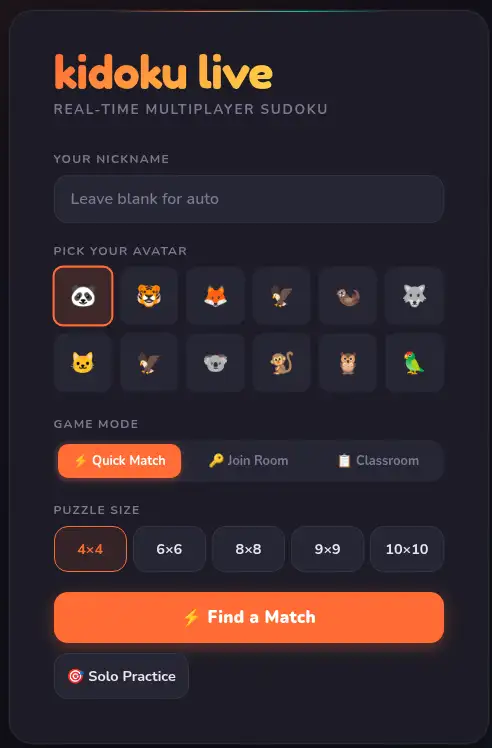
He remembered the app from a WhatsApp forward from another parent in Rohan's year. He opened kidoku.app/live, created a room, typed RAIN-06, and put the code on the living room TV before saying anything. When Zara asked what it was, he said it was a competition. "All three of you." Rohan's phone came off immediately. Mihir was already on a video call — he joined the room from his own house two minutes later.

Kiran watched how they sorted the grid choice themselves without being told. Rohan opened the game, looked at the 4×4 option and said to Zara, "You play on 4×4. Me and Mihir are doing 9×9." Zara didn't protest. The competitive arrangement was self-selected and immediately satisfying to everyone. It meant each child was playing at the right difficulty without any adult intervention.

Round one finished with Zara in first place. On paper, a 7-year-old completing Animal Grid 4×4 in 3:44 beating two 11-year-olds completing Classic 9×9 in 14 minutes is obvious. On the day, the result produced a moment of genuine delight for Zara and a competitive response from the older two. Round two: they played fairer. Rohan chose 6×6 the second time. Mihir stayed on 9×9. Zara stayed on 4×4 but was now under pressure to defend.

The rain stopped at 3:30. Kiran mentioned this once. Nobody moved. He mentioned it again at 4 PM. Mihir had left his video call on but put his headphones in. Rohan was working on a Hall of Fame time. Zara had joined the Grand Prix solo after they'd finished the room and had placed 4th in her age group. Kiran made tea, accepted the afternoon, and was grateful.

When Mihir went home at 5, he asked Kiran to text him the URL. His own parents would want it, he said, for situations exactly like today.

Mixed Ages, Same Room, Different Difficulty Levels

A 7-year-old and an 11-year-old can play in the same room because Kidoku automatically adjusts. Everyone competes. Nobody is patronised or overwhelmed.

🌧️

1. Open a Room, Post the Code on the TV

RAIN-06 on the living room screen. Each child joins on their own device. A remote friend can join from a video call — same room code works across any device, any location.

🎁

2. Each Player Chooses Their Grid Size

4×4 Animal for the youngest. 6×6 Classic for the middle. 9×9 for the most experienced. Each player selects their own difficulty when they join. No adult intervention needed. They sort it themselves.

🌤️

3. The Rain Stops. Nobody Notices.

The unstructured rainy afternoon is the hardest to manage. Kidoku Live is the unplanned solution. Once it starts, it runs on its own. The afternoon that looked like friction sorts itself into engaged, competitive, cross-age play.

The Game That Finds its Own Level for Every Player in the Room

device_hub

Cross-Device, Cross-House Play

One child in the room. One on video call from their house. Both in the same Kidoku room. The friend two streets away is as present in the competition as the sibling next to you on the sofa.

child_care

Youngest Can Win, Honestly

On Animal Grid 4×4, a 7-year-old can genuinely beat two 11-year-olds on 9×9 by time. The result is legitimate. Zara placed first. The older two debated strategy. This dynamic repeats itself in every mixed-age session — the younger child isn't patronised, they're competing.

repeat

Afternoon-Length Without Repetition

Each round generates a new puzzle. Two hours of rainy afternoon produces eight or nine rounds. When the private room runs out, the Grand Prix continues solo. The game doesn't have a natural ending — it has a natural next stage.

RAIN-06 · Round 3 Results

🏆

RohanFast (6×6)

Switched to 6×6 — took the lead back

9:14 — 1st

🦁

ZaraStar7 (4×4)

Defending from round 1 win

4:01 — 2nd

📱

MihirGrid (9×9)

Joined from video call next street

Still going strong

Three hours. The afternoon the parents didn't have to manage.

The Screen Time That Parents Don't Feel Bad About

Rainy day screen time usually means passive content consumption. Kidoku Live is active, competitive, logic-building play — the kind of screen time that doesn't require negotiation.

  • check

    Active problem solving — constraint elimination, logical deduction, spatial reasoning. Not passive content. Not a distraction.

  • check

    No ads, no external links, no social media — the interface is the puzzle. There is nothing else on screen. No rabbit holes.

  • check

    Auto-generated usernames, no chat — safe for every child in the room, including friends joining remotely from their own homes.

Start the Rainy Day Room
🌧️

The rain stopped. Nobody went outside until 5. Kiran made tea and accepted the afternoon gratefully.

That's the product. An afternoon that could have been difficult, solved by a URL and a room code. Mixed ages, different devices, one friend joining remotely. The game found its own level for everyone.

FAQ

Frequently Asked Questions

Everything you need to know about Kidoku Live for this use case.

What is a good rainy day activity for kids of different ages?

Kidoku Live handles mixed ages without any adult adjustment. Younger children play on 4×4 Animal Grid, older children on 6×6 or 9×9 — all in the same private room. The time-based leaderboard allows the youngest child to beat the oldest fairly. One URL, one room code, and the afternoon manages itself.

Can a child on a video call join a sibling's game?

Yes. The friend on a video call opens kidoku.app/live on their own device and enters the room code. They compete in the same live session as the siblings in the house. Kidoku Live has no dependency on geographic co-presence — any player anywhere with the room code can join.

How long does a session last for rainy day play?

Individual sessions take 5–15 minutes. After one session ends, the next is created in under 10 seconds. Most children play 6–10 rounds in an afternoon without prompting. Two hours of rainy-day screen time via Kidoku involves active logical thinking for the entire period — no passive consumption.

Is Kidoku Live different from other rainy day screen time?

Most rainy day screen time alternatives are passive: video streaming, social media scrolling, or solo gaming. Kidoku Live is active, competitive, cognitively demanding, and social. It is screen time that parents can explicitly leave children to without guilt — the activity is inherently self-regulating through the competitive structure.

Do the different devices cause any unfairness?

No. Kidoku Live renders identically on phones, tablets, and laptops. The puzzle and controls are the same regardless of device. Screen size makes no meaningful difference to solving speed because the logic is the determining factor, not the interface. A child on a small phone competing against a sibling on a large tablet is not disadvantaged.

The Afternoon the Parents Didn't Have to Manage

Rain, mixed ages, one kid on a video call. One URL sorted the entire afternoon. That's the one you keep bookmarked.

Mixed ages welcome · Cross-device play · No accounts required