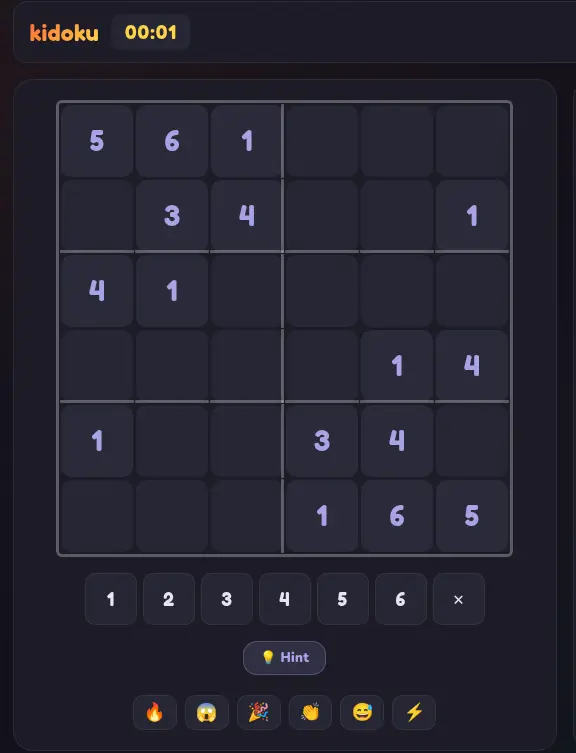
Mr Patel runs it every Monday. Year 8 students settle instantly. They're already thinking in elimination and constraint satisfaction before the lesson begins. That's exactly the abstract reasoning he needs them to practise.
verified_user No IT approval · Zero data collected · Works on any browser
Year 8 · Monday Opener
8×8 Classic Grid
02:18
First finisher
Mr Patel teaches Year 8 maths. His challenge every Monday morning is the same: get 28 students' brains into abstract reasoning mode within the first five minutes.
Starter activities typically take longer to set up than they do to run. Kidoku Live changed that.
He puts the code on the board as students file in. By the time the register is done, 26 of them are already in the lobby. He selects 8×8, hits start, and the room falls silent — the productive silence of people actively thinking.
The skill they're using is constraint satisfaction: "Given what's fixed, what's the only possibility?" That's algebra. That's proof. That's the abstract reasoning the curriculum demands.
He's tried the themed version — Superhero Squad — and uses it explicitly as a lesson on abstraction: "You're not solving a number puzzle. You're solving a constraint problem. The symbols are just labels. They could be variables."
The lesson is 10 minutes older before he says anything that would appear on an exam. But students are already thinking the way he needs them to.
No accounts, no prep, no worksheet printing.
Open kidoku.app/live on the projector. Create a Classroom Room. 6-digit code appears. Write it on the board. Students open their own device and join.
Year 7 → 6×6 to start. Year 8 and above → 8×8 or 9×9. The same constraint logic scales with difficulty. Set the level to match your class.
Hit pause mid-game and project the leaderboard. Ask the leader to explain their elimination strategy. Use the theme (Superhero Squad) to introduce symbol abstraction.
"What number can go here given all the constraints?" Same cognitive skill as solving simultaneous equations or logic proofs. They practise it willingly.
The themed Superhero version uses symbols where numbers go. The constraint logic is identical. Use it to introduce the concept that maths operates on labels, not inherent meanings.
The live timer and opponent feed creates productive pressure. Students scan faster, eliminate quicker, internalise patterns. Speed comes from accuracy, not guessing.
Year 8 Class Leaderboard · 8×8
Start with a 10-minute opener. Build to a cross-class tournament.
Private room, one class. The Monday opener. Students join before the bell, race during the warm-up. 8 minutes, no prep, full engagement.
Use for the abstraction lesson. Same constraint logic, symbols instead of digits. Introduces the idea that maths operates on labels, not inherent values.
Run a school-wide battle between form groups. All classes, same puzzle, same start time. Top 10 go on the public Hall of Fame.
Secondary schools have more stringent data requirements. Here's exactly what you need for your safeguarding and data leads.
Zero personal data collected — no names, emails, or identifiers. By architecture, not policy.
Auto-generated nicknames — students cannot enter real names. Animal nickname system only.
No communication features — emoji reactions only. No text chat, voice, or direct messaging.
Room controlled by teacher — see all nicknames, remove students, pause at any time.
Monday · Year 8 · 8×8
28 students in-game
Everything you need to know about Kidoku Live for this use case.
Kidoku Live requires constraint-elimination reasoning — identifying what is impossible before placing what is certain. This is Bloom's Taxonomy level 4–6 thinking: analysis, evaluation, and synthesis applied to a logic grid. Unlike quiz tools that test recall, Kidoku tests active deductive reasoning under timed competitive conditions.
Kidoku Live is used most frequently with Year 6–10 (ages 10–15). The 8×8 and 9×9 grids provide the right level of challenge for secondary students. The 10×10 grid suits extension students or maths clubs. For mixed-ability classes, differentiated instruction is built in — students choose their grid size to match their level.
Yes. Constraint logic is a foundational STEM thinking skill used in computer science, engineering, and mathematics. Kidoku Live teaches it through competitive play. Teachers of STEM subjects use it as a cognitive warm-up, an end-of-term activity, and a cross-curricular logic challenge. No computers expertise is needed to run a session.
It serves a different purpose. Kahoot tests factual recall of content already taught. Kidoku Live develops active reasoning skills — useful alongside content revision rather than instead of it. Many secondary maths teachers use both: Kahoot for knowledge recall, Kidoku for logic and problem-solving. The two tools complement each other.
Yes. The live leaderboard on the teacher's screen updates the moment each student submits a completed puzzle. Teachers project this onto a whiteboard. Students can see their live position as they work. The competitive dynamic this creates drives engagement — even students who rarely participate become invested in their leaderboard placement.
Yes. Constraint propagation — the algorithm underlying sudoku solving — is a core concept in computational thinking. Kidoku Live sessions can be prefaced with a discussion about how computers solve constraint problems. This makes it a natural bridge between maths and computer science, applicable across multiple curriculum areas.
No data is collected from students at any point. There are no accounts, no names, no emails, and no persistent user records. The auto-generated username lasts only for the session. Most schools are able to deploy Kidoku Live without any DPO review because there is no personal data flow to review.
The 3-minute lesson opener that teaches constraint logic. Open the room on Monday morning and see what happens.
Used by secondary maths teachers · Free tier · No IT approval