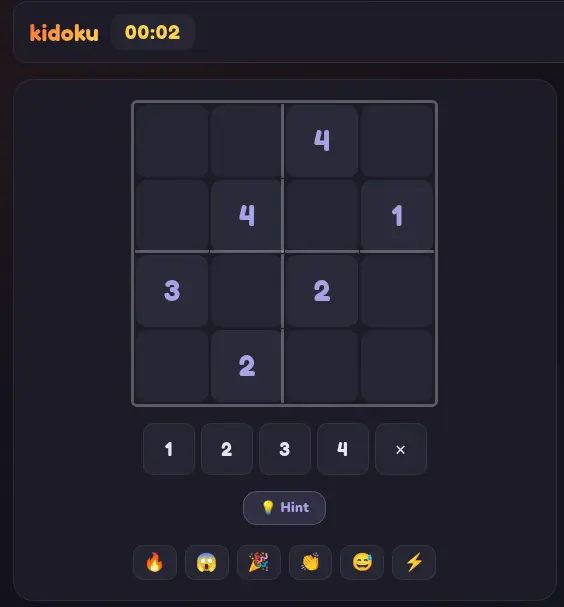
Between Tuesday and Thursday, Vikram sent the link with a note: "Play three Quick Match games before our next session." She played seven. The following Thursday he reviewed her game patterns for ten minutes, then moved straight into the constraint logic she'd discovered on her own. They skipped a week of groundwork.
verified_user No account needed ยท Student plays independently ยท Practice that compounds between sessions
Between-Session Homework
Thursday: skip the basics. Start with strategy.
Vikram tutors Year 6 students in maths, two sessions per week. The constraint: 50 minutes per session, most of it review, consolidation, or new concept introduction. Deliberate practice โ the kind that builds fluency โ rarely fits in a tutoring hour.
He started sending Kidoku as a between-session activity after noticing a student who found procedural maths frustrating but excelled at visual pattern recognition. He sent her kidoku.app/live with a note to "play three games before Thursday."
She played seven. He saw this because she screenshotted her results and sent them in a message. The message said: "I think I figured something out. If you know one number in a row, you sometimes know another one automatically."
That was the constraint propagation insight. In formal maths terms, it's the foundation of logical deduction from given information. She'd derived it herself through repeated play, without terminology, without instruction.
Thursday's session opened with Vikram saying: "Tell me what you figured out." She spent twelve minutes explaining constraint elimination in her own language. He spent the remaining thirty-eight minutes naming the phenomenon, extending it, and applying it to algebraic substitution problems she'd previously found opaque.
He now sends Kidoku between every session for students working on logical reasoning. The homework compliance rate is 100%. Several students play more than assigned. The sessions are more advanced because the groundwork has been laid between them.
The session results give you a starting point for the next tutoring hour. Between-session practice compounds the session work instead of letting it cool.
Message or email kidoku.app/live with a session count target. Three games. Five games. Whatever fits the interval. No instruction beyond "play." The game teaches itself in the first session.
Live competition sessions motivate continued play. The student isn't grinding through worksheets โ they're competing in real time. Compliance is high because the activity is intrinsically engaging, not just assigned.
Ask the student to describe what they noticed. Their spontaneous discovery of constraint logic gives you a direct window into their reasoning. The session starts from their insight, not from your instruction.
Between sessions is normally where learning fades. Kidoku reverses this โ students get better between sessions because they keep playing, and the next session picks up from a more advanced starting point.
Constraint-based elimination is the underlying skill in algebra, logic proofs, and systematic problem solving. Practising it through Kidoku builds the mental habit you're trying to develop in session โ without it feeling like practice.
Assigned number of games is a floor, not a ceiling. Competition sessions create intrinsic motivation. Students typically play more than assigned because they want to improve their ranking, not because they feel obligated to complete homework.
Between Tuesday and Thursday
Vikram's session note:
"Play three Quick Match games before Thursday. Try to notice what helps you place numbers faster."
Student's message, Wednesday evening:
"I think I figured something out. If you know one number in a row, you sometimes automatically know another one. I played 7 games btw."
Thursday session:
Opened at constraint propagation. Skipped two weeks of groundwork.
Your student is playing alone between sessions. The environment needs to be safe for independent use without parental supervision or your presence. Kidoku is designed for exactly this scenario.
No accounts, no registration โ student opens the link and plays. No sign-up, no personal data collected.
No chat in Quick Match โ standard sessions have no player-to-player communication. Safe for independent use.
Content-safe environment โ entirely self-contained puzzle game. Nothing to navigate away to, nothing to unlock, nothing to buy.
Between-session practice that's self-directed, competitive, and cognitively active. The logical work happens between your hours with them.
Everything you need to know about Kidoku Live for this use case.
Yes. The tutor shares the URL kidoku.app/live and tells the student to complete a set number of Grand Prix entries or Quick Match sessions before the next tutoring session. There are no accounts or results to submit โ the student's personal best time and leaderboard positions serve as evidence of practice.
Yes, directly. Non-verbal reasoning tests assess pattern recognition, spatial logic, and matrix completion โ all of which are reinforced through repeated Kidoku Live play. Tutors who specialise in 11+ and grammar school entrance test preparation use Kidoku as a daily practice tool alongside formal test papers.
Nothing. Kidoku Live is free for students to use. The tutor shares the URL, the student plays. No per-session fees, no account required, no parental payment needed. An optional Kidoku Plus upgrade exists for individual users but is never needed for assigned practice work.
There is no formal tutor dashboard. Students can note their Grand Prix rankings and personal best times to report at the next session. Many tutors treat this self-reporting as a secondary skill โ noting performance data and reflecting on improvement. The informal reporting creates accountability without requiring a managed account system.
Constraint elimination, systematic scanning, forward inference, and error-checking habits. These are the same reasoning skills tested in 11+, ISEB, and similar entrance assessments. Daily 20-minute practice across six weeks produces measurable improvement in structured logical reasoning that transfers directly to academic settings.
Three games. Or seven. However many they play, the next session starts from a better place. The between-session gap is now working for you.
No account needed ยท Self-directed ยท Works between any two sessions