👨‍👧 Parent vs Child · Private Room · Role Reversal

You Started It to Get Them Into It. They Beat You by Game Two.

Priya introduced Kidoku to her son Arjun thinking she'd be the teacher. Game one: she won, explaining things. Game two: he beat her without any help. Game six: she was bracing herself and fully focused. They play every Sunday evening in their private room. The series is 11–9. He leads. She doesn't let that go easily.

verified_user No accounts · Private room just for two · Real competition at any age

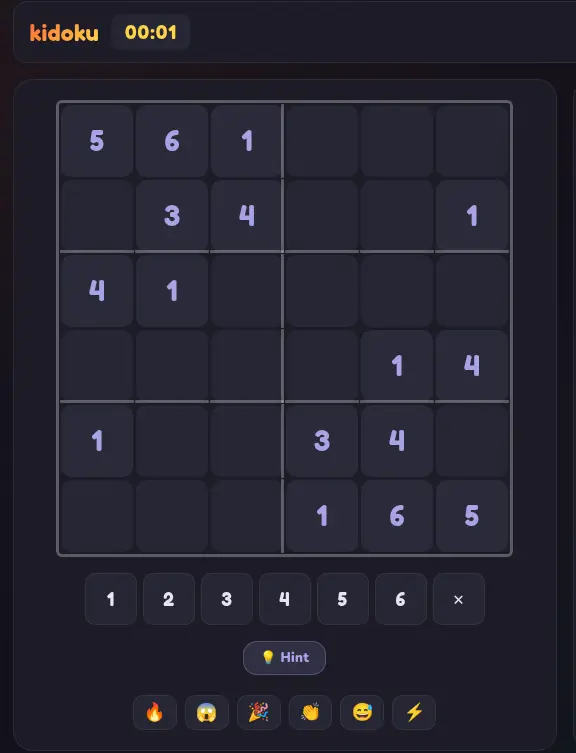
kidoku live screen

Room: HOME-77 · Sunday

PurpleMum 🟣 Mum 6×6
SpeedKid99 ⚡ Arjun 6×6

Series total: SpeedKid99 leads 11–9

Game 21. Mum is actually trying this time.

"REMATCH!" 😤

Game One Was Teaching. Game Six Was Competing.

Priya found Kidoku through her daughter's school. She set it up on a Saturday afternoon thinking Arjun — nine years old — might like puzzle games. She played game one with him, openly explaining: "See, if this row has a 3 and a 5, the only missing number between 1 and 6 must fill those other cells."

Game one: Priya won. Arjun asked to play again. Game two: she started the same explanation. He didn't need it. He finished the grid in 4:49. She hadn't finished. She sat looking at the "SpeedKid99 — 1st" notification, genuinely surprised.

Game three: she stopped explaining and started playing. She finished second. He was immediately curious about how he could get faster. She was curious about how he'd done it at all.

By game six, the room code HOME-77 existed, they had their own private session, and Priya was playing the grid with the same focus she brings to work problems. Arjun had switched to telling her she was going too slowly. The role reversal was complete and neither of them had planned for it.

The series counter started informally. Priya mentioned offhand that it was 3–3. Arjun remembered the count from then on. By session fifteen, it had become the number they both knew without needing to discuss it. Series scores are tracked in his head with more precision than she tracks budget figures.

The genuinely competitive part, Priya says, is that she can't let herself be sentimental about losing. It started as a parenting activity. Now she plays to win. He plays to win. Neither of them wants to lose. The game made both of those things simultaneously true.

How the Parent-Child Series Starts

Private room. Two players. A series counter. The point at which the parent realises they're actually trying is usually around game four.

🏠

1. Create the Private Room

One person opens kidoku.app/live and creates a private room — HOME-77, COUCH-22, whatever generates. Share the code with the other player. Both join on different devices. No account, no setup.

⚔️

2. Same Grid, Side by Side

Both players get the same grid. The race is live. When one finishes, the timer keeps running for the other — no stopping the game. The result shows who was faster. Rematches start in seconds.

📊

3. The Series Keeps Itself

Private room sessions accumulate win counts automatically. The series counter becomes the number you both know. Neither of you has to remember — it's there when you open the room.

The Game That Doesn't Know Who the Adult Is

balance

No Age Advantage Built In

Kidoku doesn't give adults an advantage for being adults. Constraint logic at speed is pure pattern recognition and working memory. Children are often faster. The game is earned, not granted by life experience.

sports_esports

Real Competition Between Any Two Players

The private room doesn't know who's the parent and who's the child. It records wins. The series goes to whoever is faster across the most sessions. That's the point.

favorite

The Competitive Bond Is the Point

The series that started as a parenting activity becomes a genuine rivalry. Both players want to win. Both players respect when the other wins. That's the kind of bond you can't plan for but always remember.

HOME-77 · All-Time Record

Game 1 (Teaching mode)

Mum explains, Mum wins

PurpleMum 🟣

Game 2 (First surprise)

No explanation needed

SpeedKid99 ⚡

Overall series

21 games played

SpeedKid99 11–9 🏆

Game 22 is scheduled for Sunday.

Private Room. Just the Two of You.

Your private room is exactly that: private. The room code brings in only the players you share it with. No public matchmaking, no strangers joining your HOME-77.

  • check

    Closed session — only players with the exact code can join. No one else in the game.

  • check

    No accounts — auto-generated usernames only. No login required for either player.

  • check

    Safe for children playing with parents — no chat, no external links, no advertising. Just the puzzle and the result.

Create HOME-77 Right Now
🏠

The game you started to get them interested. The series that made you both competitors.

Private room. Same grid. Two players. One of them is going to win. That's the whole thing.

FAQ

Frequently Asked Questions

Everything you need to know about Kidoku Live for this use case.

Can a parent and child play sudoku together online?

Yes. Both players visit kidoku.app/live from their own devices. The parent creates a private room and shares the 4-letter code. Both players join and solve the same puzzle simultaneously. The live leaderboard shows both positions as they work. No accounts are needed for either player.

How do you keep the competition fair between a parent and a young child?

The parent chooses a harder grid size — 9×9 — while the child plays on 4×4 or 6×6. The time-based leaderboard is fair across grid sizes: a child who finishes 4×4 in 4 minutes can beat a parent who finishes 9×9 in 15 minutes. As the child's skill improves over weeks, the parent needs to increase their own performance to keep the competition close.

Does playing sudoku together have educational benefits?

Yes. Beyond the logic benefits for the child, parent-child competitive play provides: incidental teaching moments (the parent explains their approach), motivation through competition with a trusted person, a shared language around logical problems, and a daily ritual that is screen-time with clear cognitive benefit.

How do I track who is winning across multiple sessions?

Kidoku Live doesn't maintain a persistent series tracker — players note results informally. Most families keep a simple tally, which becomes part of the ritual. Some families run named series tracking who leads across a month. The Grand Prix personal best records provide an alternative objective performance comparison.

What grid size should a parent use to make it competitive with a 9-year-old?

Most parents find 8×8 or 9×9 is the right level to keep competition close against a practised 9–11 year old on 6×6 or 8×8. As the child improves (typically faster than the parent), adjust to 10×10. The goal is to keep the parents' completion time within reach of the child's completion time adjusted for grid size.

Create the Room. Start the Series.

You're going to help them understand the puzzle. Then they're going to beat you. Then you're going to ask for a rematch.

Private room · No accounts · Works on any two devices

Parent vs Child Sudoku Game — Free Live Multiplayer

The dynamic of playing against your own child is unusual: you want them to do well, but you also don't want to obviously lose on purpose — both of you know the difference. Kidoku Live handles this naturally with different grid sizes. Parent on 9×9, child on 4×4 — the parent is genuinely challenged while the child competes on their own level. Both finish in a similar time. Both feel the competitive tension.

Why Different Grid Sizes Create Fair Competition

A parent solving a 9×9 in 8 minutes and a child solving a 4×4 in 3 minutes are both playing at the limit of their current ability. The live leaderboard shows both players — position is determined by completion time relative to session participants, creating genuine competitive uncertainty even between players of very different ability levels.

The Natural Progression as Children Improve

Most parent-child pairs report a clear arc over weeks: the child starts on 4×4 and wants to move up because they beat the parent too easily. The parent moves to 10×10 to compensate. Eventually the child reaches the parent's grid size — and stays there. Many families describe the day their child first beats them on the same grid as a genuine milestone.

Building a Family Routine Around the Daily Session

Families who play Kidoku together regularly report the daily session becoming a ritual: same time, same private room code, a quick two or three rounds before dinner. The competitive structure means both participants are genuinely engaged — it is one of the few screen activities that a parent and child can do together without one person being bored.

Frequently Asked Questions

Can we play from different rooms in the house?

Yes. Each player uses their own device and connects via the same four-letter room code. You can be in different rooms, different floors, or even different houses — the session works the same way.

What if the child is better than the parent?

Move the parent up to a harder grid size. The flexibility of grid selection means the parent can always find a level that is genuinely challenging for them, keeping the competition honest.

Is Kidoku Live free?

Yes. The entire game — Quick Match, Grand Prix, private rooms, and all themes — is completely free to play. No subscription is needed to access any feature.

Does it require an account or sign-up?

No account is required. Players join with a 4-letter room code and are assigned a safe auto-generated username for the session. No personal information is collected.

Also see: Sudoku across generations · Brothers and sisters competing

Related Guides