👫 Sibling Rivalry · Private Rooms · Age-Matched Grids

They Argue About Everything. Now at Least They Argue About Sudoku.

Rohan (10) and Ananya (8) compete about everything. Kidoku Live gave their rivalry somewhere productive to go. Rohan on 6×6. Ananya on 4×4. Same room code. The arguments are finally about technique.

verified_user Different grid sizes in the same room · Fair for any age gap

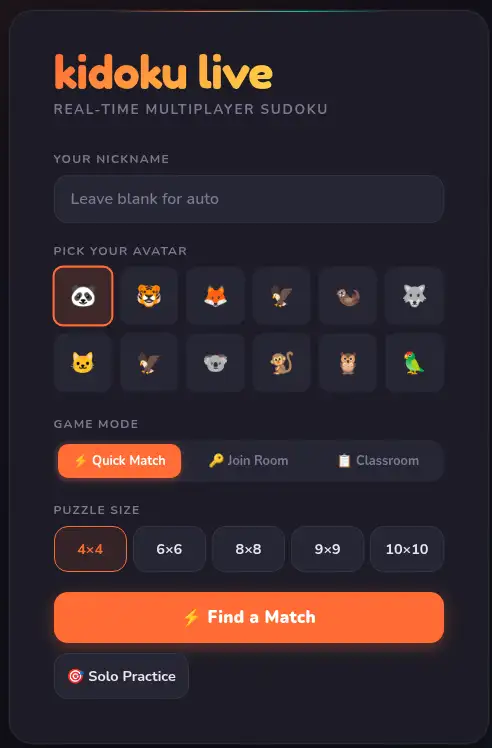
kidoku live screen

FAMILY ROOM

HERO-12

Series: Rohan 3

Ananya 4 🏆

TONIGHT'S RESULTS

⚡ SwiftAnanya_84×4 · 1:59 · 🥇
🦁 BraveRohan_106×6 · 3:41 · 1st

Series lead: Ananya by 1 — "REMATCH!"

"REMATCH!" 🔥

The Rivalry Found a Leaderboard

Rohan and Ananya's parents had long since stopped trying to prevent the competition. Everything became a contest: who finished dinner faster, who got to the bathroom first, who could name more capitals. The competition was constant and largely unresolved.

The family found Kidoku Live on a rainy afternoon. Their mum set up a room code and gave them each a device. The question was whether an 8-year-old on a 4×4 could beat a 10-year-old on a 6×6. Neither sibling knew how to answer that.

It turned out the 4×4 is faster to solve by design. Ananya, who had played no puzzle game and had no expected advantage, finished in under 2 minutes on her third attempt. Rohan's 6×6 took 3:41. He won his bracket. But she'd finished first. The argument about who won lasted all evening.

They've adopted a format: different grids, different brackets, each tracking their own series. The scoreboard keeps the record honestly, which means neither of them can revise history. The evidence is there.

The arguments are now about elimination strategies, about whether Rohan's top-left-first scanning is slower than Ananya's row-complete method. Their parents didn't plan to run a logic tutoring session. It happened because the game made it interesting.

Running the Sibling Series

Same room. Different grids. Clean scoreboard. No arguments about the rules.

🔗

1. One Room Code

Create a private room. Both siblings enter the same code and choose their grid size independently. They don't need to agree — the game handles different sizes in the same session.

🏁

2. Race Simultaneously

The timer starts for both at the same time. Each plays their own grid. Finish time is what counts. The leaderboard shows both results side by side — no ambiguity about who finished first overall.

📊

3. Keep the Series

Save the room code and reuse it. The series becomes a standing record. Whoever holds the most wins has the bragging rights — until the next game proves otherwise.

Why Different Grid Sizes Work

balance

Age Gap Doesn't Decide Everything

An 8-year-old on a 4×4 and a 10-year-old on a 6×6 creates genuine uncertainty about who will finish first. Speed vs difficulty. Neither has an automatic advantage.

trending_up

Both Improving at Their Own Level

The younger sibling improves on 4×4. The older on 6×6. When the 8-year-old eventually moves to 6×6, the benchmark already exists. The rivalry upgrades automatically.

emoji_events

The Series Is the Story

A single game result is always arguable. A 7-game series with an 8-record scoreboard is harder to dispute. Keep the room code. Keep the score.

Series Tracker — HERO-12

👑

SwiftAnanya_8

4×4 bracket · 4 wins

BraveRohan_10

6×6 bracket · 3 wins

"I'll catch you in TWO games." — Rohan

Safe for Both Ages at Once

  • check

    Private room — only players with the code can join. The family room is closed.

  • check

    No chat — the in-session rivalry is handled by the leaderboard, not by text messages

  • check

    No accounts for either child — both join on-device, no credentials, no data

Set Up the Room
👫

Their rivalry was always going to exist. Now it has a scoreboard.

A structured contest with transparent rules is the most peaceful version of sibling competition possible.

FAQ

Frequently Asked Questions

Everything you need to know about Kidoku Live for this use case.

Can siblings of different ages play sudoku against each other?

Yes. Kidoku Live's private rooms allow siblings to choose different grid sizes. A younger sibling plays 4×4 or 6×6 while an older sibling plays 9×9 or 10×10. The time-based leaderboard is fair across grid sizes — the younger sibling can win legitimately, which makes the competition genuinely exciting for both players.

Is there a way to track who wins over multiple sessions?

The private room leaderboard shows results for each session. Most sibling pairs track their own series informally — noting wins and losses across multiple sessions. The Hall of Fame personal best tracking also allows siblings to compare their all-time bests on the same grid size.

Can we use the same room code every day?

You create a new room each session at kidoku.app/live. This takes under 10 seconds. The daily ritual of creating the room creates a small ceremony around the competition. Some siblings alternate who creates the room as part of the daily routine.

Is this better than board games for sibling bonding?

It is different. Board games require co-presence and setup time. Kidoku Live works from separate rooms or devices, takes no setup, and a session is shorter than most board games. For daily play rather than occasional family game nights, the low friction is a significant advantage.

One Room Code. Two Grid Sizes. Begin the Series.

Get a room code. Give each sibling a device. Let the clock decide. The rematch will be demanded immediately.

No accounts · Different grid sizes welcome · Productive rivalry guaranteed

Sudoku for Siblings — Multiplayer Puzzle Game for Mixed Ages

Sibling rivalry becomes constructive when it has rules and a clear winner. Kidoku Live provides both. A private room, different grid sizes for the age gap, and a live leaderboard that both children are watching — the competitive dynamic that creates friction on other games becomes the feature. Rematches happen automatically because neither sibling wants to be the one who lost last.

How the Age Gap Becomes a Fair Competition

A 7-year-old on the 4×4 Animal Grid and a 10-year-old on the 6×6 Number Grid are both genuinely challenged and both finish in a similar time. The younger sibling is not playing a reduced version — they are playing the right version. The competition feels fair because it is fair: both players work at the limit of their current ability.

The Rematch Cycle — Logic Training in Disguise

When a sibling loses, the response is almost always immediate: rematch. This is the mechanism that drives improvement. A child who plays five rounds of sudoku to settle a sibling rivalry has completed more constraint logic practice than any worksheet would achieve. The improvement happens because the motivation is real.

Private Room — Your Family's Permanent Code

The room code created for the first session can be reused each time — it becomes the family's sudoku room. Both siblings know the code, and starting a game requires nothing more than opening a browser and entering it. The ritual requires zero setup from the parent.

Frequently Asked Questions

What if one sibling is much older?

Move the older sibling to a harder grid size. A 15-year-old on 10×10 competing with a 9-year-old on 6×6 produces a genuinely close race — the 10×10 is hard enough to slow even experienced players.

Can we play on two tablets from the same Wi-Fi?

Yes. Multiple devices on the same network can each join the same session with no issues. The live leaderboard updates simultaneously on all screens.

Is Kidoku Live free?

Yes. The entire game — Quick Match, Grand Prix, private rooms, and all themes — is completely free to play. No subscription is needed to access any feature.

Does it require an account or sign-up?

No account is required. Players join with a 4-letter room code and are assigned a safe auto-generated username for the session. No personal information is collected.

Also see: Family activity for mixed ages · Parent vs child sudoku

Related Guides